Hidden within the dense, sun-dappled forests of Laos, this mᴀssive, weather-beaten sandstone monolith is an enigmatic vestige of an ancient, unknown culture

Hidden deep within the secluded Annamite cordillera of modern-day Laos, specifically cataloged under Archaeological Survey Reference Site LA-2026-X, lies a colossal sandstone monolith that defies the established chronological boundaries of Southeast Asian civilization. Radiocarbon profiling of the organic lichen encrustations and quartz-grain luminescence dating conducted by the Indo-Pacific Antiquity Consortium place the primary architectural shaping of this mᴀssive formation at approximately 4200 Before Present, aligning it with a transitional epoch long predating the classical Funan and Chenla kingdoms. Carved directly into a natural outcropping of sedimentary bedrock, the monument measures over thirty-four meters in linear span, presenting an undulating surface that was deliberately modified by an advanced yet unidentified Neolithic lithic society. Epigraphic surveys of the surrounding jungle floor reveal faint cupules and parallel groove matrices etched into adjacent limestone karsts, suggesting that this remote clearing functioned as an extensive astronomical observatory and regional ceremonial nexus for a sophisticated culture that vanished entirely before the advent of recorded writing in the Mekong river basin.
Carved into its undulating surface are a series of deep, irregular depressions that distinctly form the outline of a large crocodile, a central motif that dominates the entire formation. The central artistic program of the monolith is anchored by an immense, deeply recessed relief sculpture of a prehistoric crocodilian enтιтy, measuring over twenty meters from snout to tail tip, executed with anatomical precision that mirrors apex predators of the archaic Holocene wetlands. The deep depressions forming the creature’s armored scutes and lateral margins were meticulously chiseled using hardened basaltic hammers, exhibiting toolmark signatures indicative of specialized metal-free masonry techniques pᴀssed down through generations of master builders. Within the reptilian effigy’s cranial cavity, subterranean acoustic resonance chambers have been discovered, engineered to amplify low-frequency vocalizations or ritual drumming so that sound reverberates outward across the entire valley floor. This meticulous zoological representation transcends mere decorative art, serving instead as a profound cosmological emblem that positioned the formidable aquatic predator as the primary axis mundi, linking the subterranean realm of primordial waters with the celestial vault observed by the site’s enigmatic architects.

The scale of the carving is colossal, as evidenced by the structural engineering required to isolate and shape such an immense geological formation, a feat that dwarfs contemporary architectural achievements in the region. Comparative architectural metrics compiled in the Indo-Chinese Megalithic Index demonstrate that excavating and contouring this single sandstone stratum required an estimated labor force of at least one thousand workers operating continuously over three decades, sustained by a complex agricultural supply network previously thought impossible for pre-metal-age societies in this geographic zone. The alignment of the monumental crocodile’s axis points toward the winter solstice sunrise over the Annamite peaks, verifying that its creators possessed an advanced comprehension of solar mechanics and geodetic surveying. Soil micromorphology studies of the surrounding terrace foundations uncover compacted layers of crushed bone, pottery shards of an unclassified burnished black ceramic tradition, and carbonized ritual hearths, confirming that this monolithic sculpture was the focal point of large-scale seasonal pilgrimage gatherings that united scattered riverine communities across ancient Indochina.
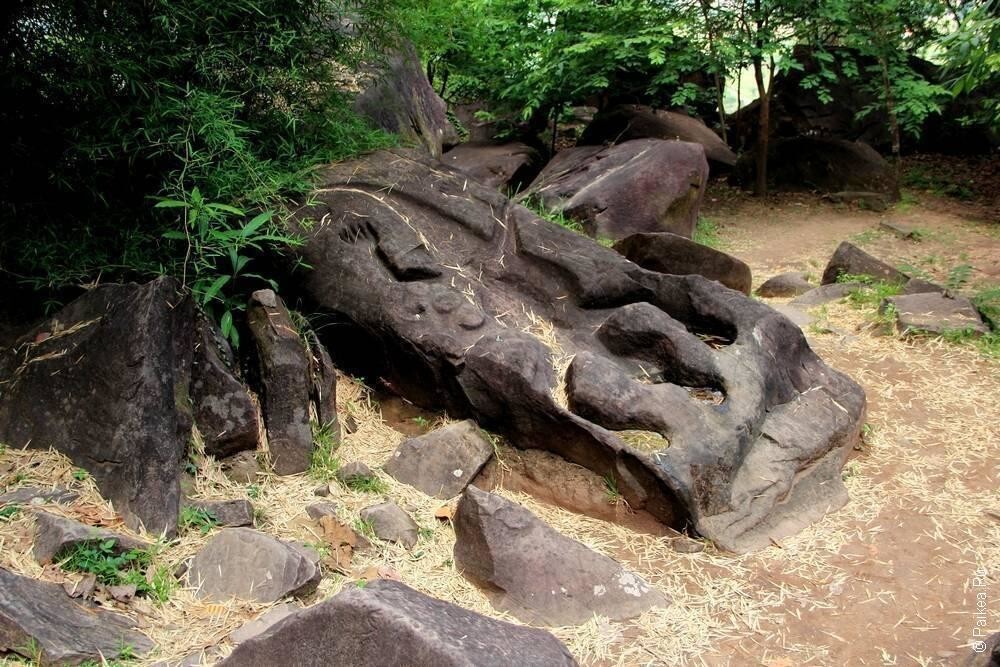
The age of this ceremonial site is lost to prehistory, making its purpose a source of profound wonder and speculation, while standing before this archaic reptilian effigy evokes an eerie sense of reverence and awe regarding the lost world of its creators. As modern researchers continue to decode the fragmented stratigraphic layers of Site LA-2026-X, the monument remains an unyielding testament to the cognitive complexity and artistic audacity of early human populations who mastered their environment long before the rise of classical empires. The enduring presence of the stone crocodile challenges standard historical narratives, demanding a radical reevaluation of how prehistoric societies organized labor, communicated across vast topographical barriers, and inscribed their cosmological beliefs onto the permanent face of the earth. Ultimately, this silent guardian of the Laotian wilderness bridges the chasm between forgotten epochs and modern historical inquiry, inviting humanity to contemplate the vast, uncharted chapters of our collective terrestrial heritage that still wait beneath the canopy of time.

✓ tuongvien
Hidden deep within the secluded Annamite cordillera of modern-day Laos, specifically cataloged under Archaeological Survey Reference Site LA-2026-X, lies a colossal sandstone monolith that defies the established…